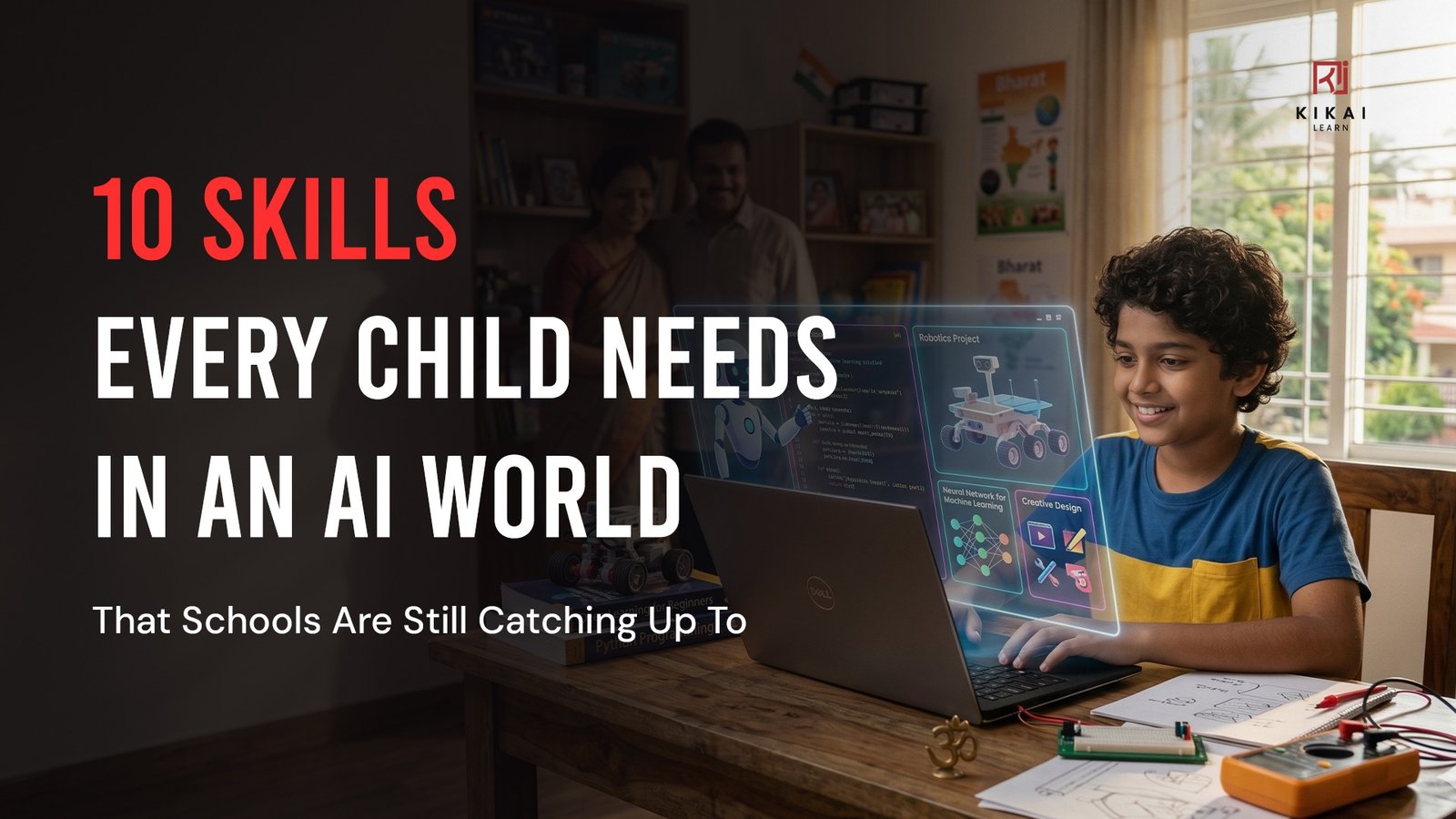
10 Skills Every Child Needs in an an AI World That Schools Are Still Catching Up To
Artificial Intelligence (AI) is no longer a technology of the future it is already transforming how we learn, work, communicate, and solve problems. Children entering school today will grow up in a world where AI assistants, automation, smart devices, and generative AI tools become a natural part of everyday life. While schools continue to play a vital role in building foundational knowledge, the rapid pace of technological change means that some of the most important future-ready skills are still not taught with enough focus or consistency.
As parents, educators, and caregivers, we need to ask an important question: Are we preparing children for the world they will inherit, or the world we grew up in?
In an AI-driven future, success will depend on much more than academic scores. Children will need to think critically, ask better questions, communicate effectively, adapt to change, collaborate with others, and use technology responsibly. These are the skills that help children not only use AI but also work alongside it creatively and ethically.
At Kikai Learn’s Gen-AI Juniors Program, we believe that children should not just consume technology, they should learn how to question it, create with it, and use it responsibly. Through project-based learning, AI tools, storytelling, website creation, and critical thinking activities, children can begin developing the human skills that will matter most in the years ahead.
The good news is that many of these future-ready skills can be developed both at home and through structured learning experiences. The challenge is that they may not always appear on report cards, even though they may be the most valuable skills children will carry into adulthood.
1. Asking Better Questions
AI tools can answer thousands of questions, but the quality of the output depends heavily on the quality of the input. Children who learn to ask specific, thoughtful questions will have a major advantage over those who accept the first answer they receive.
This skill can begin with daily life. Instead of asking, “What is AI?” a child can learn to ask, “How does AI decide what video to recommend to me?” Better questions create better thinking.
At Kikai Learn’s AI for Kids program, students learn prompt engineering and questioning techniques that help them communicate effectively with AI tools.
2. Critical Thinking
Critical thinking is one of the most essential skills in the AI era because digital tools can sound convincing even when they are wrong. Children need to examine claims, notice gaps, and compare evidence before trusting what they read or hear.
Schools do teach analysis in some contexts, but children often need much more regular practice in questioning information from technology, media, and peer conversations. This is especially important as AI becomes more common in schoolwork and search behavior.
Children should learn to ask:
Is this information correct?
Where did it come from?
Can I verify it elsewhere?
Does this answer make sense?
3. Creativity
As AI becomes better at producing standard outputs, creativity stands out as a deeply human strength. Creative children are more likely to use AI as a tool for exploration instead of letting it flatten their ideas into generic work.
Creativity includes more than art. It also includes finding unusual solutions, combining ideas from different fields, and imagining alternatives that do not yet exist.
Programs like Kikai Gen-AI Juniors encourage students to build websites, create AI storybooks, design advertisements, and produce documentaries, helping them use AI as a creative partner rather than a replacement.
4. Digital Judgment
Digital judgment means knowing when to trust a tool, when to question it, and when to stop using it. In an AI world, this includes privacy awareness, understanding the limits of automation, and recognizing that convenience can still lead to poor decisions.
Children should learn basic rules early, such as:
Never sharing personal information with AI tools
Not uploading private documents or photos
Understanding that AI-generated content may not always be correct
Recognizing misinformation and fake content
Digital judgment is quickly becoming one of the most important life skills for children.
5. Adaptability
Technology is changing fast, and many of the tools children use in five years may not even exist today. Adaptability helps them stay flexible when systems, expectations, and learning methods change.
This means children benefit from learning how to approach unfamiliar situations rather than becoming dependent on one app, platform, or routine. Adaptability is built every time a child tries a new method, recovers from failure, and adjusts strategy.
6. Communication
Children growing up with AI still need strong communication skills because ideas only matter when they can be shared clearly. Speaking, writing, listening, and presenting remain central in school and future work.
Communication also includes:
- Explaining reasoning
- Asking follow-up questions
- Giving presentations
- Collaborating respectfully
- Listening actively
These skills become even more valuable as AI handles more routine tasks.
7. Collaboration
Many future challenges will require people to work across roles, tools, and disciplines. Children need practice listening to others, sharing responsibility, and combining strengths to solve problems together.
Collaboration is not automatically learned in group projects. It improves when children are taught how to:
- Divide tasks fairly
- Respond to feedback
- Work through disagreements
- Appreciate different perspectives
At Kikai Learn, collaborative projects and presentations help students build these essential teamwork skills.
8. Resilience
An AI-driven future will reward children who can keep learning after mistakes, setbacks, or uncertainty. Resilience supports long-term growth because it helps children stay engaged when results are imperfect or delayed.
Children who only chase perfect answers may become overly dependent on AI because the tool seems faster and more certain. Resilience encourages them to stay with hard problems long enough to build real understanding.
Learning how to fail, recover, and try again may become one of the greatest competitive advantages in the future.
9. Ethical Awareness
As AI becomes more embedded in everyday life, children need a foundation in fairness, responsibility, and the social impact of technology.
Ethical awareness helps children understand:
- How technology affects people
- Why privacy matters
- How bias can exist in AI systems
- Why responsible use of AI is important
Children should understand that powerful tools also come with responsibility.
At Kikai Learn’s AI for Kids program, students are introduced to age-appropriate AI ethics and digital citizenship concepts to help them become responsible creators and users of technology.
10. Lifelong Learning
One of the clearest future-ready skills is the ability to keep learning continuously. Education experts increasingly describe lifelong learning as essential in a world shaped by AI, automation, and rapid change.
Children do not need to know every answer today. They need confidence that they can:
- Learn new skills later
- Adapt to new technologies
- Unlearn outdated habits
- Continue growing throughout life
The ability to learn may become more valuable than any single skill itself.
Why Schools May Not Be Enough on Their Own
Schools play a major role in children’s development, but curriculum change often moves slower than technology change. That creates a gap between what the world is demanding and what children practice every day.
Parents can help close this gap by treating everyday moments as learning opportunities. Dinner conversations, creative challenges, research projects, and reflective discussions all help strengthen the skills that classrooms may not always prioritize.
This is also why structured future-skills programs such as Kikai Learn’s Gen-AI Juniors Program are becoming increasingly important, helping children develop creativity, problem-solving, AI literacy, and responsible technology use alongside traditional education.
How Parents Can Build These Skills at Home
A practical home approach does not need to be complicated:
- Ask children open-ended questions instead of only giving instructions.
- Encourage them to explain how they reached an answer.
- Give space for creativity without rushing to correct every mistake.
- Let them work through frustration before stepping in too quickly.
- Discuss how digital tools work and where their limitations might be.
- Use projects that combine imagination with problem-solving, such as storytelling, research activities, or creative building challenges.
- Encourage children to use AI tools responsibly and critically.
Conclusion
The children who thrive in an AI world will not simply be the ones who use the most advanced tools first. They will be the ones who can question, adapt, create, collaborate, and continue learning as technology evolves.
Schools will continue to matter, but families have a powerful role in building the human strengths that AI cannot easily replace. Helping children develop these ten skills is one of the most practical ways to prepare them for a future that is already beginning.
For parents looking for a structured, age-appropriate, and hands-on approach to introducing AI, creativity, and future skills, Kikai Learn’s Gen-AI Juniors Program provides children with the opportunity to learn AI responsibly while developing the human skills that matter most.
Frequently Asked Questions (FAQs)
1. Why should children learn AI at an early age?
Learning AI at an early age helps children develop important future-ready skills such as critical thinking, creativity, problem-solving, and digital literacy. It encourages them to become creators and innovators rather than just consumers of technology. Early exposure also helps children understand how AI works and how it impacts their daily lives. They learn to ask better questions, think independently, and adapt to new technologies. These skills will be valuable across careers and everyday life in the future.
2. Does learning AI mean children need to learn coding?
No, children do not need to learn coding to start learning AI. They can begin by understanding AI concepts, learning how to communicate with AI tools, and using AI for creativity and problem-solving. Activities such as prompt writing, storytelling, website creation, and AI-powered projects can be done without programming knowledge. Coding can be introduced later if children develop an interest. The goal is to build AI literacy and confidence first.
3. Can AI replace traditional education?
No, AI cannot replace traditional education or teachers. AI should be viewed as a learning assistant that supports education by providing personalized explanations, practice, and creative tools. Teachers play a critical role in mentoring, motivating, and developing social and emotional skills in students. Schools also help children learn communication, collaboration, and teamwork. AI can enhance learning, but human interaction remains essential.
4. What skills are most important for children in an AI-driven future?
Some of the most important skills for children include critical thinking, creativity, communication, adaptability, collaboration, ethical awareness, resilience, and lifelong learning. These human skills will become increasingly valuable as AI handles more routine tasks. Children also need digital literacy and problem-solving abilities to navigate an AI-powered world. Developing these skills helps them become confident, responsible, and future-ready individuals.
5. Is AI safe for children?
AI can be safe for children when used responsibly and under proper guidance. Children should learn not to share personal information, verify facts, and understand that AI can sometimes make mistakes. Parents and educators play an important role in teaching safe and ethical AI usage. Children should also learn about digital privacy, misinformation, and responsible online behavior. With the right guidance, AI can become a powerful tool for learning and creativity.
6. How can parents prepare their children for an AI future?
Parents can prepare their children by encouraging curiosity, creativity, critical thinking, and problem-solving. They can have discussions about technology, support hands-on learning experiences, and encourage children to ask questions. Parents should also help children develop digital literacy and responsible technology habits. Providing opportunities to explore AI through guided activities and educational programs can build confidence and future-ready skills.
7. What is the Kikai Learn Gen-AI Juniors Program?
The Kikai Learn Gen-AI Juniors Program is a project-based AI learning program designed to introduce children to artificial intelligence in a simple, engaging, and age-appropriate way. Students learn how AI works, build creative projects, develop future-ready skills, and explore AI tools responsibly. The program includes activities such as website creation, storytelling, presentations, AI agents, and digital content creation. It focuses on creativity, critical thinking, collaboration, and ethical AI use, helping children become confident learners and creators in an AI-powered world.

Sai Ashrith