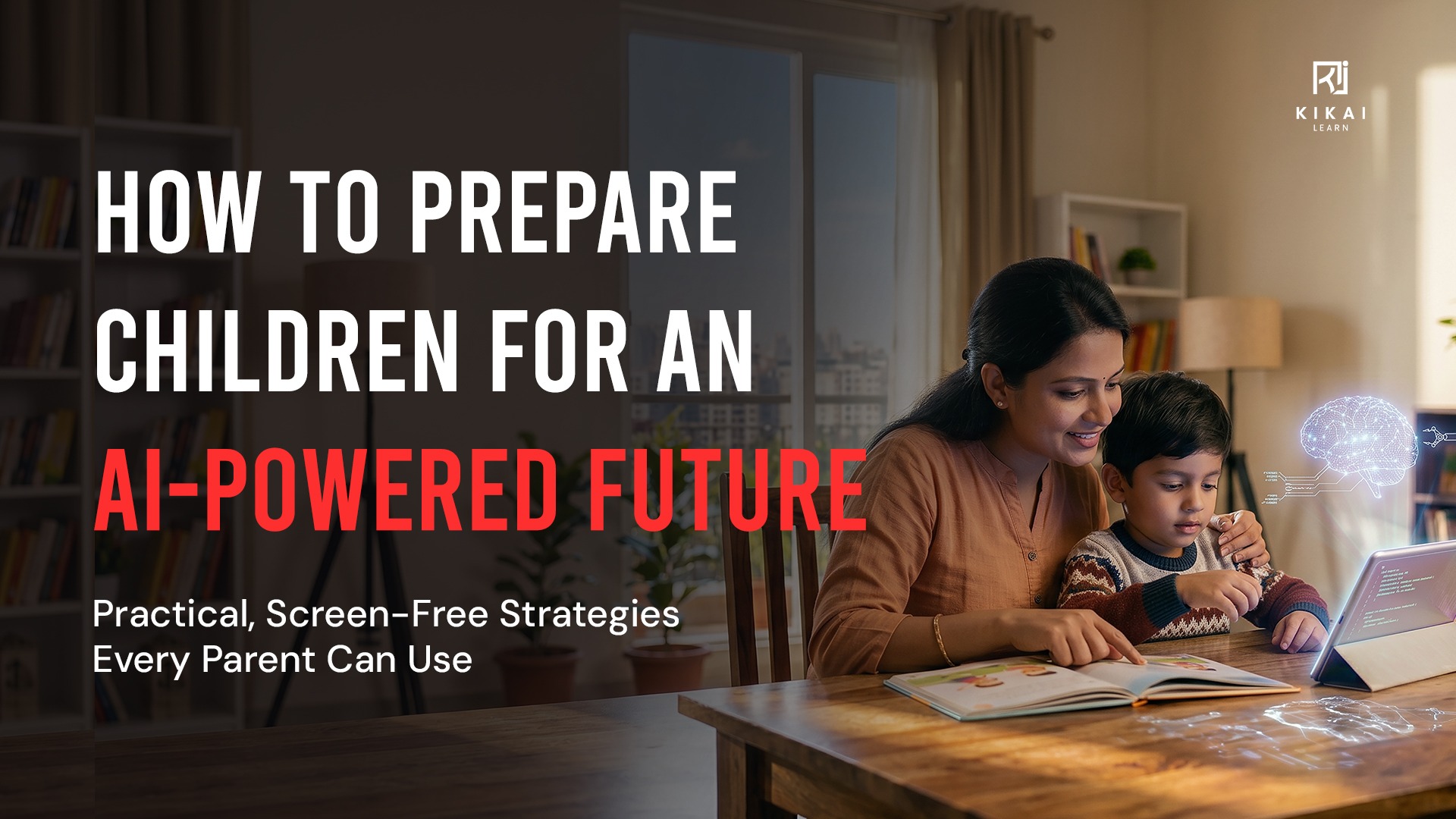

How to Prepare Children for an AI-Powered Future: Practical, Screen-Free Strategies Every Parent Can Use
The world your child will grow up in will be very different from the one you grew up in.
Imagine your child entering a workplace where AI is as common as the internet is today. They’ll collaborate with intelligent assistants, use AI to solve problems, create ideas faster, and make decisions alongside technology. In fact, according to the World Economic Forum, many of today’s children will eventually work in careers that don’t even exist yet. At the same time, Artificial Intelligence is becoming part of classrooms, search engines, creative tools, and everyday life at an unprecedented pace.
As parents, it’s natural to wonder:
- Should my child learn AI?
- Do they need coding?
- Will learning AI increase screen time?
- How can I prepare them without overwhelming them?
The encouraging news is that preparing children for an AI-driven future doesn’t start with complicated coding lessons or expensive gadgets. It starts with building the human skills that AI cannot replace curiosity, creativity, critical thinking, resilience, communication, and responsible decision-making. The best part? Many of these skills can be developed through simple, everyday activities that don’t require additional screen time.
AI is no longer a futuristic idea. It is already part of how children learn, search, play, and create online. Parents are increasingly looking for practical ways to prepare children for this shift without depending entirely on screens or turning every learning moment into a technology lesson.
The most effective preparation for an AI-driven future is not early technical mastery. It is helping children build durable human skills such as curiosity, critical thinking, creativity, resilience, and responsible decision-making.
This matters because AI will keep changing how work and learning happen, but children who know how to ask good questions, adapt to new tools, and think independently will be better prepared than children who only know how to consume technology.
Why Parents Should Start Now
AI tools have become a regular part of children’s digital environment, and online learning is becoming a more visible part of what young people search for and use. At the same time, education experts increasingly argue that future readiness depends less on memorizing facts and more on learning how to evaluate information, solve problems, and keep learning over time.
This means parents do not need to turn home into a coding lab. Instead, home can become the place where children learn how to observe, question, imagine, test ideas, and recover from mistakes. Those habits will remain valuable no matter how quickly AI evolves.
The Future Skills That Matter Most
Curiosity
Curiosity is the habit of wanting to know how something works and why it matters. In an AI-rich world, children who stay curious are more likely to explore tools thoughtfully instead of using them passively.
Parents can build curiosity by asking open-ended questions during daily life. Questions like “Why do you think the map app chose this route?” or “How do you think a voice assistant understands what you said?” can help children notice the hidden systems around them.
Critical Thinking
AI can generate quick answers, but quick answers are not always accurate. Children need practice questioning outputs, checking sources, and comparing different explanations before accepting something as true.
Critical thinking begins long before a child uses an AI chatbot. It starts when a parent asks, “What makes you think that?” or “How could we check whether that is true?” These simple prompts build the habit of pausing before believing or repeating information.
Creativity
As AI becomes better at producing text, images, music, and even code, human creativity becomes more important not less. Creativity helps children move from simply consuming ideas to shaping them into something original.
Parents can support creativity with simple offline activities such as story building, drawing alternate endings to a favorite book, designing inventions from cardboard, or inventing games from household objects. These activities train imagination, experimentation, and flexible thinking all essential skills in an AI-driven future.
Parent Tip
Encourage your child to ask “What if?” questions.
Instead of giving answers immediately, ask them how they would solve a problem differently. These small conversations help children become innovators rather than passive technology users.
Resilience
Children growing up with AI will need to adapt often. Tools will change, platforms will disappear, and new expectations will emerge in school, careers, and everyday life. Resilience helps children handle frustration, uncertainty, and failure without giving up.
Parents can build resilience by praising effort rather than outcomes. When a child struggles with a puzzle or makes a mistake during a project, the useful question is not:
“Why did you get it wrong?”
Instead ask:
“What can you try differently next time?”
Children who learn to experiment, fail, and improve will be far better prepared than those who expect instant success.
Responsible Technology Use
Knowing how to use digital tools responsibly is now one of the most valuable future skills.
Children must understand that convenience is not the same as wisdom and that technology should support learning not replace independent thinking.
Responsible technology use includes helping children understand:
- Online privacy
- Safe digital habits
- Fact-checking information
- Respectful online communication
- Healthy screen-time boundaries
Even young children can begin learning that some information should never be shared online and that AI-generated answers should always be questioned and verified.
Screen-Free Ways to Build AI-Era Readiness
One of the biggest misconceptions about AI education is that children need more devices and more screen time.
The truth is quite the opposite.
Many of the most important AI-ready skills can be developed completely offline through conversations, games, storytelling, and creative activities.
Here are some simple ways parents can nurture future-ready thinking at home.
Explain Everyday Systems
Ask your child to explain how something works.
For example:
- Traffic lights
- Elevators
- GPS navigation
- Online shopping recommendations
- ATM machines
These conversations encourage systems thinking an important foundation for understanding Artificial Intelligence.
Play Sorting and Pattern Games
Sorting toys by color, arranging objects by size, matching cards, or identifying patterns introduces children to the same logical thinking AI systems use when recognizing patterns in data.
The activity feels like play while quietly developing analytical thinking.
Read Stories Together
Pause while reading and ask questions like:
- What do you think happens next?
- Why do you think this character made that decision?
- What would you have done differently?
These discussions strengthen prediction, reasoning, empathy, and decision-making.
Encourage Invention Challenges
Give children everyday materials like:
- Paper
- Cardboard
- Tape
- Bottles
- Recycled objects
Challenge them to invent something that solves a small household problem.
This develops:
- Creativity
- Design thinking
- Engineering mindset
- Problem-solving
Have Family Discussions
Discuss current events, advertisements, books, or even movies.
Ask children:
- Do you agree?
- Why?
- What evidence supports your opinion?
- Could there be another answer?
Learning to compare viewpoints is becoming increasingly important as AI systems may generate different responses to the same question.
How to Introduce AI Without Creating Dependence
When parents begin introducing AI tools, the goal should be guided exploration, not unlimited access.
Children should learn how AI works, when to use it, and when not to rely on it.
Experts recommend introducing AI gradually while focusing on AI literacy, including understanding bias, verifying information, protecting privacy, and recognizing that AI can make mistakes.
A simple four-step framework works well for families.
Step 1: Think First
Before using AI, ask:
“What do you already know about this topic?”
This encourages independent thinking before seeking assistance.
Step 2: Ask Better Questions
Help children turn broad questions into clear, thoughtful prompts.
Instead of asking:
“Tell me about space.”
Teach them to ask:
“Why do astronauts float in space?”
or
“How does gravity work on the Moon?”
Learning to ask better questions is becoming one of the most valuable AI-era skills.
Step 3: Verify the Answer
Encourage children to compare AI-generated responses with:
- Books
- Trusted educational websites
- Teachers
- Parents
This reinforces that AI should be a learning partner not the final authority.
Step 4: Reflect
After using AI, ask:
- What surprised you?
- What did you learn?
- What would you like to explore next?
Reflection transforms AI from an answer machine into a tool for deeper learning and curiosity.
What This Looks Like at Home
Preparing children for an AI-powered future doesn’t require expensive technology or advanced technical knowledge. It starts with small, intentional moments that encourage children to think, question, create, and explore.
For younger children, this may look like storytelling, sorting games, building simple inventions from everyday materials, or conversations about how smart devices work.
For older children, it can include comparing search results, evaluating whether an AI-generated answer sounds trustworthy, discussing responsible technology use, or exploring how AI can support creativity and learning without replacing independent thinking.
The common thread isn’t technical complexity it’s thoughtful participation.
Children don’t need to master every AI tool that appears. They need to understand how to learn continuously, ask meaningful questions, adapt to change, and use technology responsibly.
These are the skills that will remain valuable no matter how AI evolves.
Why AI Education Matters More Than Ever
Artificial Intelligence isn’t replacing the need for human intelligence it is increasing its importance.
As AI becomes capable of completing routine tasks, the abilities that make us uniquely human creativity, curiosity, empathy, critical thinking, collaboration, and ethical decision-making—will become even more valuable.
Parents who begin nurturing these qualities today are giving their children an advantage that extends far beyond technology.
The goal isn’t to raise expert coders at an early age.
The goal is to raise confident learners who understand technology, think independently, solve problems creatively, and adapt to a rapidly changing world.
Conclusion
Preparing children for a world with AI does not require constant screen time or advanced coding lessons.
It requires consistent practice in the human skills that technology cannot easily replace curiosity, critical thinking, creativity, resilience, communication, and responsible decision-making.
Parents who nurture these habits at home are giving their children something far more valuable than early exposure to the latest technology.
They are helping them develop a lifelong learning mindset that will serve them throughout school, future careers, and everyday life.
The future will belong not only to those who know how to use AI, but also to those who know how to think, question, create, and lead alongside it.
Help Your Child Become Future-Ready with Kikai Learn
At Kikai Learn, we believe children should learn with AI, not simply about AI.
Our AI Junior Program is designed to introduce young learners to Artificial Intelligence through age-appropriate, hands-on, and engaging activities that build creativity, logical thinking, problem-solving, and responsible technology habits.
Rather than focusing only on coding, we help children understand how AI works, how to ask better questions, think critically, and use AI safely and ethically.
Whether your child is just beginning their AI journey or is eager to explore emerging technologies, our programs provide a strong foundation for the future.
In the AI Junior Program, children learn to:
- Understand AI through fun, interactive activities
- Develop creativity and problem-solving skills
- Learn responsible and ethical AI use
- Build confidence using age-appropriate AI tools
- Strengthen logical thinking and communication
- Prepare for an AI-powered future in an engaging, structured environment
Explore Kikai Learn’s AI Junior Program and help your child become a confident creator not just a consumer of technology.
FAQs (Frequently Asked Questions)
1. What is the ideal age for children to start learning AI?
Children can begin exploring basic AI concepts from around 7–8 years of age through interactive, age-appropriate activities. Early learning focuses on understanding AI, asking questions, creativity, and responsible technology use rather than technical programming.
2. Does my child need coding experience to learn AI?
No. Kikai Learn’s AI Junior Program is designed for beginners and does not require any prior coding knowledge. Children first learn how AI works before moving on to practical applications.
3. Will learning AI increase my child’s screen time?
Not necessarily. Effective AI education balances digital learning with discussions, creative projects, games, and hands-on activities. The goal is thoughtful learning rather than excessive device use.
4. What skills will my child develop through the Kikai Learn AI Junior Program?
Children build future-ready skills including:
- Critical thinking
- Creativity
- Problem-solving
- Logical reasoning
- Prompt writing
- Responsible AI usage
- Communication
- Collaboration
5. Why should children learn AI at an early age?
AI is becoming part of education and many future careers. Learning AI early helps children understand technology, adapt to change, and develop the confidence to use AI responsibly and creatively.
6. Is the AI Junior Program suitable for complete beginners?
Yes. The program is specifically designed for beginners and introduces AI concepts through simple explanations, engaging activities, and project-based learning.
7. How is Kikai Learn’s AI Junior Program different from coding classes?
Traditional coding classes focus on programming languages. Kikai Learn’s AI Junior Program focuses on AI literacy, creativity, critical thinking, prompt engineering, ethical AI use, and practical problem-solving skills that prepare children for an AI-driven future regardless of whether they become programmers.
8. How can parents support AI learning at home?
Parents can encourage curiosity, ask open-ended questions, read together, discuss how technology works, play reasoning games, and create opportunities for children to solve real-life problems. These everyday activities complement structured AI learning and help children build lifelong learning habits.