
AI Course vs MBA vs Certification (2026):Which One Should You Choose?
Every year, thousands of Indian students and professionals stare at the same fork in the road: spend two years and lakhs of rupees on an MBA, spend a few months and a fraction of the cost on an AI course, or collect certifications and hope they add up to something. In Part 1, we broke down what each path actually teaches. Here in Part 2, we answer the question that really decides your next five years : what does each path pay, how fast does it pay you back, and which one fits the life you’re actually living right now?
What Each Path Actually Pays in India in 2026
The biggest mistake people make with salary comparisons is anchoring on extremes.
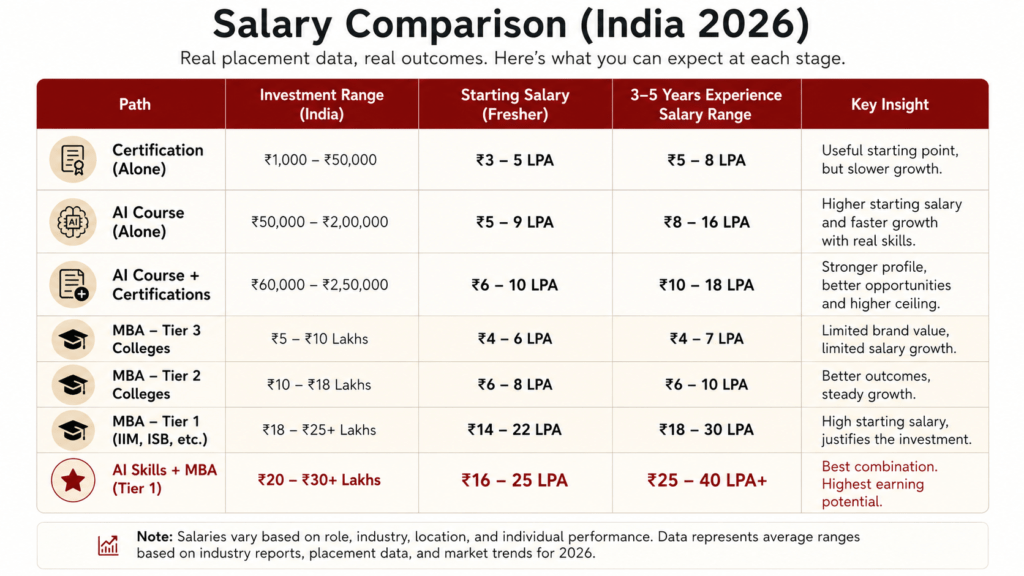
They look at an IIM graduate’s ₹22 LPA offer and assume every MBA delivers that. They look at a ₹50,000 AI course and assume it can’t possibly compete. Neither assumption survives contact with real placement data.
Here’s what the numbers actually show. A certification on its own typically starts you at ₹3–5 LPA, inching up to ₹5–8 LPA after three to five years, useful, but slow. A well-chosen AI course in the ₹50,000–₹2,00,000 range starts noticeably higher, at ₹5–9 LPA, and climbs to ₹8–16 LPA within three to five years as you build a track record. Stack an AI course on top of certifications and that ceiling rises to ₹10–18 LPA. An MBA’s outcome depends almost entirely on tier: Tier 3 colleges land graduates ₹4–6 LPA with little movement, Tier 2 does meaningfully better at ₹6–10 LPA, and only Tier 1 institutes; IIM and ISB >break into the ₹14–22 LPA range that justifies the MBA price tag on salary alone. The strongest combination on the chart, unsurprisingly, is AI skills layered onto a Tier 1 MBA: ₹16–25 LPA to start, with experienced professionals crossing ₹25–40 LPA.
The Number Most People Never Calculate: Break-Even Time
Peak salary potential makes for a good headline, but it tells you almost nothing about whether an education path is a good financial decision today. The metric that actually matters is break-even time: how long it takes for the salary increase from your education to repay what you spent on it. This is where the AI-course-versus-MBA comparison gets genuinely lopsided.
An ₹80,000 AI course that lifts your salary by even ₹2–3 LPA breaks even in roughly four months. A ₹2 lakh AI course takes about ten months. Stack certifications on top of an AI course and you’re still looking at roughly a year. Compare that to a Tier 2 MBA costing ₹12 lakh: even with a respectable ₹7–8 LPA starting salary, break-even stretches to around five years and that’s before counting the two years of income you gave up while studying full-time. Tier 1 MBAs are the one place this math flips back in the MBA’s favour, breaking even in about two to three years thanks to placements in the ₹18–25 LPA range. Everyone outside that narrow band needs to run their own numbers honestly before signing up.
Estimated break-even timelines by education path, based on course cost and average salary uplift, India 2026.
Who Should Choose What
There’s no universal right answer here, only the right answer for where you stand right now. Use the table below as a starting framework, then read the note underneath it, because the most powerful strategy in 2026 isn’t picking one path at all.
Your Profile | Best Choice | Likely Outcome |
Fresh Graduate | AI Course | ₹5–7 LPA in 6–12 months |
Working Professional | AI Course | ₹2–5L bump or promotion |
Leadership Aspirant | MBA (Tier 1 only) | Management / consulting role |
Career Switcher | AI Course | New role in 3–6 months |
Budget-Conscious | Certification + Portfolio | Entry-level role in 6 months |
Entrepreneur / Founder | AI Course + Certifications | 60–80% lower agency spend |
MBA Graduate | AI Course (Post-MBA) | ₹20–35 LPA senior roles |
Maximum ROI Seeker | AI Course + MBA (Tier 1) | ₹25–40 LPA long-term ceiling |
Why Combining Paths Beats Choosing Just One
One of the most underused strategies right now is treating this as a ‘which one first’ question instead of an ‘either-or’ decision. An MBA graduate who adds an AI course becomes a noticeably stronger hire they bring the strategic thinking and institutional credibility of the MBA, plus the practical execution skills employers actually want applied day to day. That combination consistently commands the highest salaries in India’s marketing and strategy job market.
The same logic works in reverse. A certification holder who builds a live-project portfolio through an AI course moves from ‘entry-level applicant’ to ‘mid-level specialist’ in as little as three to six months the certification proves they understand the platform, and the portfolio proves they can use it to get results. The real question was never which credential to chase. It’s which one to get first, and what to stack on top of it once you’ve proven you can execute.
Six Mistakes That Cost People Years and Lakhs
These aren’t hypothetical. Each of the following has genuinely derailed careers and drained savings for people who chose an education path for the wrong reason.
- Choosing an MBA out of peer pressure. It usually comes from a fear of being ‘left behind’ after graduation, with no clear goal behind the decision. Map your five-year goal first, then ask honestly whether the role you want actually requires an MBA. Most don’t.
- Collecting certificates without ever applying them. It feels productive each new badge gives a small sense of progress but it builds no real proof of skill. Finish one certification, then build a single live project around it before you move on to the next.
- Ignoring practical AI skills entirely. This usually comes from overconfidence in existing qualifications and an assumption the market will stay stable. It won’t. Even a free or micro AI course in your specific domain is a better use of a weekend than another resume update.
- Choosing a course on price alone. Budget pressure crowds out the more important question: what does this do to your salary trajectory over the next three years? Divide course cost by expected annual salary gain that’s your real break-even number, and it should drive the decision, not the sticker price.
- Doing an MBA from a low-ranked college. This comes from believing the word ‘MBA’ carries value on its own, regardless of which institution grants it. A Tier 3 MBA can cost ₹8 lakh and deliver ₹5 LPA. A well-chosen ₹1 lakh AI course can beat that return outright.
- Rushing into an AI course without a plan. Marketing hype sells a lot of courses to people who never define what they actually want from them. Decide your outcome first a job, a promotion, or a freelance income stream and choose the course that’s built for that specific outcome.
Why 2026 Is Genuinely Different
It would be easy to wave this off as the same debate that resurfaces every few years in a new wrapper. But the data this time is harder to dismiss. The World Economic Forum’s Future of Jobs Report 2025 projects 37 percent job growth tied directly to AI by 2030 exclusively for people who already have the relevant skills. The same report names analytical thinking, creative problem-solving, and technology literacy as the three most critical skills for the next five years. A traditional MBA program covers the first one well. A well-built AI course covers all three.
India’s digital economy is moving at a pace that makes the talent gap impossible to ignore. With over 800 million internet users and businesses pouring money into digital advertising, automation, and analytics, demand for AI-literate marketing professionals is expected to cross 10 lakh job openings by 2026. Companies cannot find enough qualified people fast enough which means the opportunity window for anyone willing to upskill now is unusually wide.
HubSpot’s AI Trends 2026 Global Survey found that 96 percent of content marketers already use some form of AI in their work, with SEO specialists at 93 percent and demand-generation teams at 89 percent. The average marketer is saving 6.1 hours a week using AI tools. A course that doesn’t seriously engage with AI doesn’t just leave graduates underprepared it leaves them behind from day one. Layer onto that the fact that search itself has split into three overlapping disciplines SEO, AEO (Answer Engine Optimisation for voice and featured snippets), and GEO (Generative Engine Optimisation for AI search tools like Google AI Overviews and Perplexity) and it’s clear why a marketer who only knows classic SEO is already a step behind.
Why More Students and Professionals Are Choosing Kikai Learn
The biggest flaw in most traditional learning is simple: people spend months on theory and walk away without a single job-ready skill to show for it. Kikai Learn was built around the opposite premise that practical, AI-powered, real-world execution is what actually moves a career forward. Programs are built around practical implementation, hands-on AI tools and workflows, live marketing campaigns, automation systems, portfolio-building projects, and execution that mirrors what employers are hiring for right now.
Whether you’re a student trying to build future-ready skills, a working professional looking to move faster, or someone planning a complete career change, the goal is the same: skills designed for the economy AI is actually creating, not the one that existed five years ago. Kikai Learn is FIIB-certified, has trained over 1,500 learners across 150+ AI tools, includes a guaranteed internship, and was recognised as India’s Promising EdTech Impact Maker 2025, with coverage in Times of India and India Today.
Build the skills this entire guide is about
Join the PG Certificate in AI & Digital Marketing , live cohorts, 150+ AI tools, guaranteed internship Assistance , and a portfolio you can actually show employers.
Frequently Asked Questions
Q: Is an MBA still worth it in 2026?
Yes, but mainly at Tier 1 institutes, IIM Ahmedabad, IIM Bangalore, IIM Calcutta, and ISB. Their brand, alumni network, and placement infrastructure still deliver returns most alternatives cannot match for corporate leadership paths. A Tier 2 or Tier 3 MBA, on the other hand, is a much riskier bet: fees of ₹10–15 lakh against an average placement of ₹6–8 LPA rarely pays off quickly. Run the ROI math before committing.
Q: Can AI courses replace an MBA?
For most practical, execution-focused roles, yes, and often more effectively. AI courses teach the tools, workflows, and hands-on skills employers are actually hiring for right now. What they don’t replicate is the institutional brand, peer network, and structured leadership thinking an MBA provides for C-suite ambitions. The two serve different goals, not the same one.
Q: Which has a better return on investment in India?
For the large majority of students and professionals, an AI course wins decisively on speed. A ₹1 lakh AI course that lifts your salary to ₹7 LPA within 12 months beats a ₹15 lakh MBA that gets you to ₹8 LPA after four years, purely on the numbers. The clear exception is Tier 1 MBA placements in the ₹18–25 LPA range, those justify both the cost and the wait.
Q: Can I do both an AI course and an MBA?
Absolutely, and many of the highest earners do exactly this. AI skills make you a stronger MBA applicant and a sharper graduate once you’re in the program. Post-MBA AI upskilling is also increasingly common, since companies now expect management hires to understand automation and data-driven marketing at a practical level, not just a strategic one.
Q: Do certifications have real value in 2026?
As a supplement, definitely. As a standalone qualification, their impact is limited without a portfolio behind them. Google, Meta, and HubSpot certificates still add credibility for entry-level applications, but interviewers increasingly ask to see actual work, campaigns you’ve run, dashboards you’ve built, not just the badge on your LinkedIn.
Q: What salary can I expect after an AI course in India?
Entry-level graduates typically land ₹5–7 LPA. With two to three years of experience layering in performance marketing and automation skills, that climbs to ₹8–14 LPA. Prompt engineers and AI marketing specialists command ₹10–16 LPA, and freelancers serving international clients on platforms like Upwork routinely cross ₹15–40 lakh annually.
Q: Is a digital marketing AI course actually recognised by employers in India?
Yes, what matters most is verifiable accreditation (such as FIIB certification), a portfolio of live projects, and placement or internship support, not the certificate name alone. In 2026, employers care far less about which course you took and far more about whether you can run a campaign, build an automation, or apply AI tools to deliver results from your very first week.
Q: How much time per week do I need to complete an AI marketing course?
Most programs built for working professionals expect around 5 to 8 hours a week, spread across weekend or evening live sessions. That’s deliberately realistic , the goal is to let you upskill in parallel with your job, not put your income on pause to do it.
Q: Is it too late to start an AI career path in 2026?
Not even close. Adoption is still in its early-to-mid growth phase, and the talent gap is widening rather than closing. Professionals who start now are positioning themselves ahead of the much larger wave of upskillers expected to enter the market over the next two to three years.
Q: What’s the difference between SEO, AEO, and GEO, and why does it matter for my career?
SEO optimises for traditional search rankings, AEO (Answer Engine Optimisation) targets voice search and featured snippets, and GEO (Generative Engine Optimisation) targets AI-generated answers in tools like Google AI Overviews and Perplexity. Marketers who only know classic SEO are already operating at a disadvantage , all three are now considered baseline, hireable skills.
The Right Choice Depends on Your Career Goal
If your goal is leadership and corporate management, a Tier 1 MBA remains the right call, brand and network still matter at that altitude. If you want the lowest-cost way to test the waters, a certification is a reasonable supplement, though not a destination on its own. If what you want is fast, practical, future-ready skills with the quickest path to a portfolio, an AI course is the clear winner. If you’re switching careers into digital or tech and can’t afford to pause your income, an AI course again wins on speed, most people re-enter the job market in three to six months. And if your goal is the maximum long-term earning ceiling, the combination of an AI course with a Tier 1 MBA outperforms either path alone.
One thing is genuinely clear heading into the rest of 2026: the job market is rewarding people who can adapt, execute, and use AI effectively, and that requirement isn’t going away. Degrees still matter in specific, narrow contexts. Practical, demonstrable skills are no longer a nice-to-have; they’re the baseline. The window to build them is open, but every month it stays open, more people walk through it. The earlier you start, the bigger that advantage compounds.